Inbox Panel
In the Chemotion ELN, the inbox collects files before they are assigned to elements. It is opened with the Inbox button in the top bar, which slides the inbox panel out on the left of the workspace. There are several ways to get data into the inbox, and it is closely linked with the integrated devices as well.
Transfer data to the inbox using email
One of the easiest ways to transfer data to Chemotion ELN is to send it via email. Users can easily send themselves files by emailing them from their registered email addresses to some predefined email address. The email address to use for sending the files is now visible in the inbox popup window.
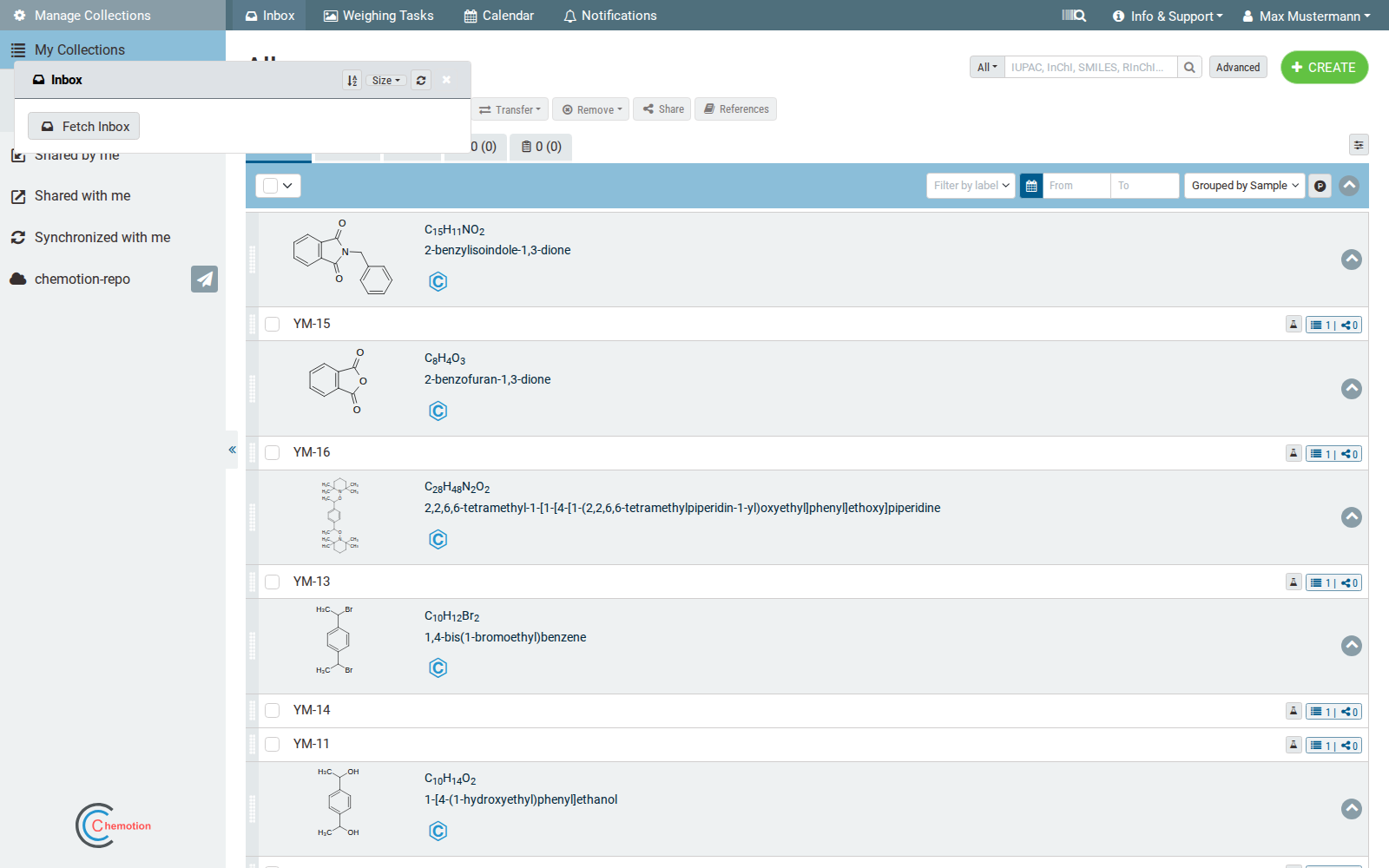
Senders of files to this email address will receive them straight into their inbox.
Regarding the Mail collector
Transfer data to the inbox using data collector
Data collector configurations have been done in many of the integrated devices. For these, files/folders are being collected automatically and when the name of the file/folder starts with a unique identifier registered with the Chemotion ELN user accounts, those reach the user's inbox at regular intervals of time.
Regarding the Data collector
Manual upload
Along with all these, users can manually upload some files in the inbox which they can later use in further analyses.
Moving files to elements (into the analyses section)
Manual import of files from the inbox into the analyses section
When working with datasets, users can drag and drop files directly from the inbox into Analyses.
Alternatively, users can use the buttons next to the file in the inbox to open a dialog that suggests elements that the data should be assigned to.
In this dialog, users can select the appropriate element and assign the file to it. A new Analysis is created, including this file as a dataset.
The list of available elements in the inbox depends on the file name, as the system automatically searches for elements with matching or partially matching names.
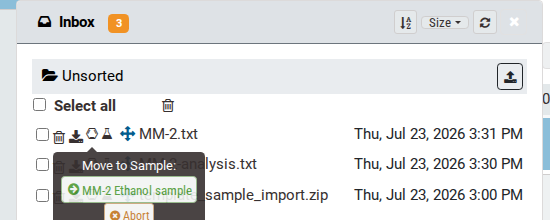
The file name (excluding the file extension) should contain:
- The full name of the element or a part of it
- The short label of the element or a part of it (e.g. CU1-1)
Automatic transfer of files from the inbox
If the file name of an item in the inbox can be uniquely assigned to an existing element (currently only samples and reactions),
the file will be automatically assigned to it.
The automatic assignment of the data to the sample or reaction creates a new Analysis with the file added as a dataset.
This feature can be disabled in the user configuration.
Reaction variations link
When a user assigns a file to a reaction and this reaction has one or multiple variations,
the resulting Analysis can automatically be linked to a variation.
To enable this, the filename needs to consist of:
- full name or short label (part)
- A minus (-) sign followed by v + variation index
- optional file extension
Example name: CU1-R1-v1.dat